
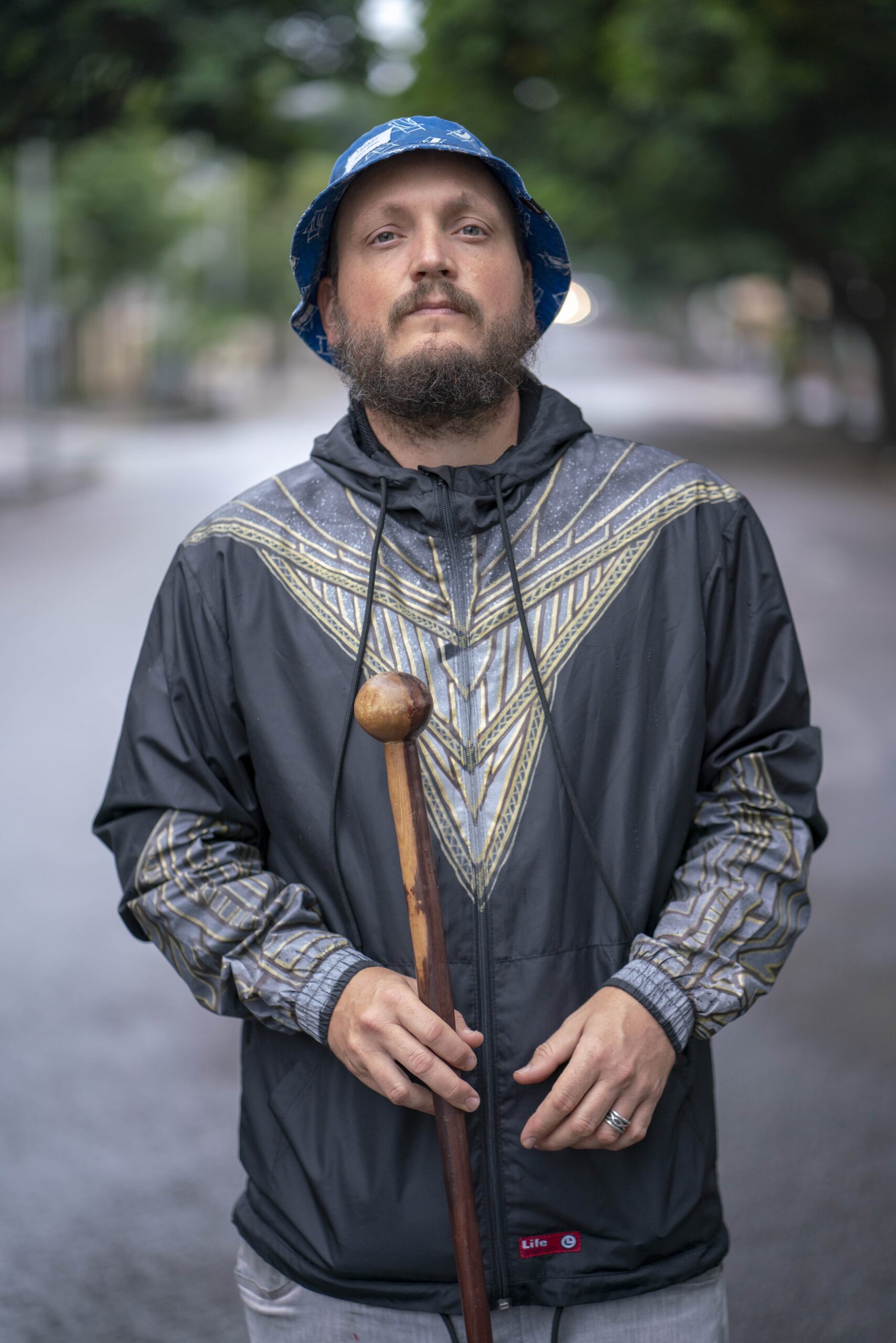
Iain EWOK Robinson is a Spoken Word Hip Hop activist and educator.
His career has crystalised at the intersection of the arts and social justice. Ewok’s critical lyrical form was forged in the freestyle battle rap and poetry slam scene. As a theater maker and independent musician EWOK uses his words to stimulate debate and awaken critical consciousness. He is a qualified performance educator, a published poet and playwright, and a professional aerosol artist producing street art that both provokes and promotes. He has worked as a member or in close association with an array of civil society organizations including the UKZN Center For Civil Society and BDS South Africa. From 2021 to 2025 he served on the National Steering Committee of the Theater And Dance Alliance.
Photo Credit: Bruce Buttery
1. What inspired your journey into spoken word and hip-hop, and how have your diverse artistic pursuits influenced your approach to social justice?
An early love in my life for language and lyrics led me to discover the language arts and artists that I loved listening to, which led me to hiphop culture and lyricists that performed with a strong sense of social responsibility. Hiphop culture and Spoken Word practice offer opportunities for self-expression that are best realised through interacting with others, particularly when that interaction is grounded in shared experience and aspiration. You just learn more about other people and what links you to them, you learn to care about the stories and lived experience of others.
2. As a graffiti artist, actor, and musician, how do these different art forms intersect in your work to convey messages of activism and education?
All of these art forms are creative interactions between a performer and a spectator, between the observer and the observed, message driven forms between a sender and a receiver. They all cause you to consider an audience in creating your work and developing your art. Activism and education are similar practices of social interaction that ask you to consider yourself, the individual, in relation to community. It’s difficult, even antithetical, to practice any of these art forms in isolation and derive any satisfaction, so they share the same impetus as activism and education, to communicate.
3. How has your background as a qualified educator shaped your methods of engaging audiences and communities through art?
It’s actually the other way around. I’ve been engaging audiences and communities through art for most of my career and only arrived at formal education relatively recently, where my artistic practice informed my understanding of education and assisted me in earning a qualification. For me, art and education are the same in that they both recognise and respond to creativity and learning as human instincts that they draw from.
4. Having performed internationally, how do you perceive the global reception of South African spoken word and hip-hop culture?
Hiphop culture and Spoken Word practice cut straight through identities of nationality and statehood, even disabling language barriers. You can step into any cipher in the world if you know how to.
5. Can you share your experiences working with organisations like the UKZN Centre For Civil Society and BDS South Africa, and how these collaborations have impacted your activism?
Organisations like these that work to formulate broad strategies of activism and direct civil-society action are critical in developing and maintaining spaces and sites of political activity outside of hegemonic government or state structures. The area of The Commons that these organisations occupy is incredibly important in allowing artists a space to develop themselves by situating their work within frameworks of critical discourse and consciousness.
6. Your one-man spoken word theatre shows have received acclaim. What challenges and rewards have you encountered in merging theatre with spoken word poetry?
Going solo on stage for any length of time is always a challenge but the medium of Spoken Word and the culture of Hiphop are both rooted in the development of a strong sense of self, informing both your content and your delivery, rewarding both the intention of the performer and the attention of the audience. You learn to hold your own and to offer that opportunity to others.
7. What strategies do you employ to inspire and mentor the younger generation of artists in South Africa?
The main strategy is to inculcate a sense of art and creativity as intrinsic to living and enjoying a satisfied life, to convince them of the benefits of a dedicated artistic practice beyond the typical commercial or consumer considerations of entertainment as employment.
8. How has your artistry evolved over the years in response to the changing socio-political landscape of South Africa?
Ironically, the further South Africa has come from a legislated system of race based discrimination, the more focussed the lens and the deeper the conversation has become regarding racialism and persistent structures of racism, so I’ve gone from what I consider my surface understanding of identity politics to a more introspective personal understanding. I guess I’ve gone from doing more speaking to doing more listening, from orchestrating shouting matches to studying the silences.
9. Looking ahead, what projects or initiatives are you most passionate about pursuing to further the causes you advocate for through your art?
In 2024 I released new material and began performing as Eon the Mod (www.eonthemod.com) and this is where I will be locating the majority of my art and activism going forward. It is a collaboration with my good friend, the French musician and composer Charles Amblard. We call it Poetrycore, poetry for protest and dance for disorder. Beyond the music and the live performance, we are building our online identity to be able to publish across multiple platforms and participate in the creative resistance against the rise of authoritarianism and fascism and the cheap consumer slop of AI.
10. AfriArtsConnect is building a platform to unite and empower South African artists through collaboration, resources, and industry support. As someone deeply involved in the arts and activism, how would you encourage fellow artists to engage with and contribute to this platform, and what role do you think collective action plays in strengthening the local arts industry?
The typical accusation levelled against artists in the creative and cultural industry is that we aren’t organised, that we don’t “speak with one voice”. Despite ample evidence to the contrary, artists have somewhat embodied this stereotype, to our continuing detriment. We have come to believe that we aren’t organised and so we don’t believe in organising ourselves, so we fall at the first hurdle. We fall into a kind of desperate every-man-for-himself competition for the next commission or grant instead of recognising our inherent strength as co-creatives and collaborators. Platforms like yours offer artists an opportunity to organise themselves, to establish themselves as professionals by connecting with one another and by learning about and participating in the creative and cultural ecosystem.
Photo Credit: Bruce Buttery


